Archives

gravatar

ccna 4 chapter 6 question and answer, cisco question and answer, cisco tutorial

CCNA 4 Chapter 6 Question and Answer

(Total 26 Question and Answer)

1. Which two protocols can be used to encapsulate traffic that is traversing a VPN tunnel? (Choose two.)
ATM
CHAP
IPsec
IPX
MPLS
PPTP 
2. What are the three main functions of a secure VPN? (Choose three.)
accounting
authentication
authorization
data availability
data confidentiality
data integrity
3. Data confidentiality through a VPN can be enhanced through the use of which three encryption protocols? (Choose three.)
AES
DES
AH
hash
MPLS
RSA

>> Read More Download This File PDF Format

or

>> Download PDF File (From Server 2)

Note : Download Will Start in new tab.


>> Read More Download This File PDF Format

or

>> Download PDF File (From Server 2)

Note : Download Will Start in new tab.

gravatar

ccna 4 chapter 5 question and answer, cisco question and answer, cisco tutorial

CCNA 4 Chapter 5 Question and Answer

(Total 26 Question and Answer)

1. The following commands were entered on a router: 
Router(config)# access-list 2 deny 172.16.5.24 
Router(config)# access-list 2 permit any 
The ACL is correctly applied to an interface. What can be concluded about this set of commands?
The wildcard mask 0.0.0.0 is assumed.
The access list statements are misconfigured.
All nodes on the 172.16.0.0 network will be denied access to other networks.
No traffic will be allowed to access any nodes or services on the 172.16.0.0 network. 
2. Interface s0/0/0 already has an IP ACL applied inbound. What happens when the network administrator attempts to apply a second inbound IP ACL?
The second ACL is applied to the interface, replacing the first.
Both ACLs are applied to the interface.
The network administrator receives an error.
Only the first ACL remains applied to the interface.
3. Which two statements are correct about extended ACLs? (Choose two)
Extended ACLs use a number range from 1-99.
Extended ACLs end with an implicit permit statement.
Extended ACLs evaluate the source and destination addresses.
Port numbers can be used to add greater definition to an ACL.
Multiple ACLs can be placed on the same interface as long as they are in the same direction.

>> Read More Download This File PDF Format

or
>> Download PDF File (From Server 2)

Note : Download Will Start in new tab.

gravatar

ccna 4 chapter 4 question and answer, cisco question and answer, cisco tutorial

CCNA 4 Chapter 4 Question and Answer

(Total 23 Question and Answer)

1. Which two statements are true regarding network security? (Choose two.)
Securing a network against internal threats is a lower priority because company employees represent a low security risk.
Both experienced hackers who are capable of writing their own exploit code and inexperienced individuals who download exploits from the Internet pose a serious threat to network security.
Assuming a company locates its web server outside the firewall and has adequate backups of the web server, no further security measures are needed to protect the web server because no harm can come from it being hacked.
Established network operating systems like UNIX and network protocols like TCP/IP can be used with their default settings because they have no inherent security weaknesses.
Protecting network devices from physical damage caused by water or electricity is a necessary part of the security policy.

2. Which two statements are true about network attacks? (Choose two.)
Strong network passwords mitigate most DoS attacks.
Worms require human interaction to spread, viruses do not.
Reconnaissance attacks are always electronic in nature, such as ping sweeps or port scans.
A brute-force attack searches to try every possible password from a combination of characters.
Devices in the DMZ should not be fully trusted by internal devices, and communication between the DMZ and internal devices should be authenticated to prevent attacks such as port redirection.

>> Read More Download This File PDF Format

or
>> Download PDF File (From Server 2)

Note : Download Will Start in new tab.


3. Users are unable to access a company server. The system logs show that the server is operating slowly because it is receiving a high level of fake requests for service. Which type of attack is occurring?
reconnaissance
access
DoS
worm
virus
Trojan horse

>> Read More Download This File PDF Format

or
>> Download PDF File (From Server 2)

Note : Download Will Start in new tab.

gravatar

ccna 4 chapter 3 question and answer, cisco question and answer, cisco tutorial

CCNA 4 Chapter 3 Question and Answer

(Total 23 Question and Answer)

1. Which three actions might a Frame Relay switch perform when it detects an excessive build-up of frames in its queue? (Choose three.)
puts a hold on accepting frames in excess of the CIR
drops frames from the queue that have the DE bit set
reduces the number of frames it sends over the link
re-negotiates flow control with the connected device
sets the FECN bit on all frames it receives on the congested link
sets the BECN bit on all frames it places on the congested link

2. Which best describes the benefit of using Frame Relay as opposed to a leased line or ISDN service?
Customers can define their virtual circuit needs in far greater combinations, with increments as small as 64 kbps.
Customers pay for an end-to-end connection that includes the local loop and the network link.
Customers only pay for the local loop and the bandwidth they purchase from the network provider.

Connecting new sites requires new lower cost circuit installations when compared to ISDN dialup costs or adding additional hardware for leased service.

>> Read More Download This File PDF Format

or
>> Download PDF File (From Server 2)

Note : Download Will Start in new tab.

gravatar

ccna 4 chapter 2 question and answer, cisco question and answer, cisco tutorial

CCNA 4 Chapter 2 Question and Answer

(Total 23 Question and Answer)

CCNA4Chapter2V4.0Answers thumb CCNA 4 Chapter 2 V4.0 Answers 
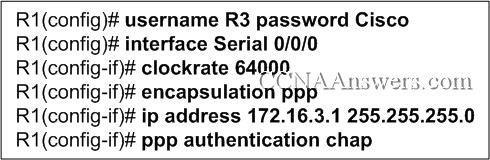
1. Refer to the exhibit. Router R1, the DCE device, has just been configured for PPP encapsulation with authentication. What series of commands will allow another router, the DTE device, to communicate over its serial 0/0/0 interface to router R1?
Router(config)# hostname R3
R3(config)# username R1 password Cisco
R3(config)# interface Serial 0/0/0
R3(config-if)# encapsulation ppp
R3(config-if)# ip address 172.16.3.3 255.255.255.0
R3(config-if)# ppp authentication chap
Router(config)# hostname R3
R3(config)# username R3 password Cisco
R3(config)# interface Serial 0/0/0
R3(config-if)# encapsulation ppp
R3(config-if)# ip address 172.16.3.3 255.255.255.0
R3(config-if)# ppp authentication chap
Router (config)# username Router password Cisco
Router (config)# interface Serial 0/0/0
Router (config-if)# clockrate 64000
Router (config-if)# encapsulation ppp
Router (config-if)# ip address 172.16.3.1 255.255.255.0
Router config-if)# ppp authentication chap
Router (config)# username R1 password Cisco
Router config)# interface Serial 0/0/0
Router (config-if)# clockrate 64000
Router config-if)# encapsulation ppp
Router (config-if)# ip address 172.16.3.1 255.255.255.0
Router (config-if)# ppp authentication chap

2. Which serial communications DTE/DCE interface standard is used to provide high-speed connectivity of up to 52 Mbps between LANs and is found on many high-end Cisco routers?
EIA/TIA 232 (RS-232)
EIA/TIA 422 (RS-422)
EIA/TIA 423 (RS-423)
EIA/TIA-612/613 (HSSI)
ITU V.35

3. Which three statements are true regarding LCP? (Choose three.)
It is responsible for negotiating link establishment.
It negotiates options for Layer 3 protocols running over PPP.
It uses MD5 encryption while negotiating link establishment parameters.
It terminates the link upon user request or the expiration of an inactivity timer.
It can test the link to determine if link quality is sufficient to bring up the link.
It monitors the link for congestion and dynamically adjusts the acceptable window size.

>> Read More Download This File PDF Format

>> Download PDF File (From Server 2)

Note : Download Will Start in new tab.


gravatar

ccna 4 chapter 1 question and answer, cisco question and answer, cisco tutorial

CCNA 4 Chapter 1 Question and Answer

(Total 23 Question and Answer)

1. Which statement is true about the differences between a WAN and a LAN?
WANs generally support higher bandwidth than LANs support.
A WAN link typically traverses shorter geographic distances than a LAN link traverses.
A WAN often relies on the services of carriers, such as telephone or cable companies, but a LAN does not.
All WAN implementations generally use the same Layer 2 protocol but there are many accepted LAN Layer 2 protocols in use.

2. A U.S. company requires a WAN connection used only to transfer sales data from individual stores to the home office. All transfers will occur after business hours. The required bandwidth for this connection is estimated to be less than 38 kbps. Which type of connection requires the least investment for this company?
ATM
ISDN
analog dialup
T1 Leased Line

>> Read More Download This File PDF Format

>> Download PDF File (From Server 2)

Note : Download Will Start in new tab.

>> Read More


gravatar

ccna 1 chapter 3 question and answer, cisco question and answer, cisco tutorial question and answer

CCNA 1 Chapter 3 Question and Answer

(Total 23 Question and Answer)

1. What application layer protocol is commonly used to support for file transfers between a client and a server?
HTML
HTTP
FTP
Telnet 
2. What are two forms of application layer software? (Choose two.)
applications
dialogs
requests
services
syntax

3. A network administrator is designing a network for a new branch office of twenty-five users. What are the advantages of using a client-server model? (Choose two.)
centralized administration
does not require specialized software
security is easier to enforce
lower cost implementation
provides a single point of failure

>> Read More Download This File PDF Format

>> Download PDF File (From Server 2)

Note : Download Will Start in new tab.

>> Read More

gravatar

ccna 3 chapter 7 question and answer, cisco exam question and answer, download ccna 3 chapter 7 question and answer,routing protocols and concepts tutrial

CCNA 3 Chapter 6 Question and Answer

(Total 23 Question and Answer)


1. Which two statements concerning network security are accurate? (Choose two.)

802.11i uses 3DES for encryption.
Open authentication uses no client or AP verification.
The 802.11i protocol is functionally identical to WPA.
802.11i incorporates a RADIUS server for enterprise authentication.
A wireless client first associates with an AP and then authenticates for network access.

2. Which installation method will allow connectivity for a new wireless network?
set up WEP on the access point only
set up open access on both the access point and each device connected to it
set up full encryption on the access point while leaving each device connected to the network open
set up full encryption on each device of the WLAN while leaving the access point settings open

3. Which function is provided by a wireless access point?
dynamically assigns an IP address to the host
provides local DHCP services
converts data from 802.11 to 802.3 frame encapsulation
provides a gateway for connecting to other networks.

>> Read More Download This File PDF Format

>> Download PDF File (From Server 2)

Note : Download Will Start in new tab.

>> Read More


gravatar

ccna 3 chapter 6 question and answer, cisco exam question and answer, download ccna 3 chapter 6 question and answer,routing protocols and concepts tutrial

CCNA 3 Chapter 6 Question and Answer

(Total 23 Question and Answer)


1. What are the steps which must be completed in order to enable inter-VLAN routing usingrouter-on-a-stick?
Configure the physical interfaces on the router and enable a routing protocol.
Create the VLANs on the router and define the port membership assignments on the switch.
Create the VLANs on the switch to include port membership assignment and enable a routing protocol on the router.
Create the VLANs on the switch to include port membership assignment and configure subinterfaces on the router matching the VLANs.

2.
CCNA3Chapter6V4.0Answers1 thumb CCNA 3 Chapter 6 V4.0 Answers
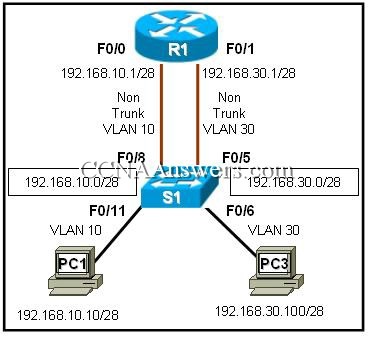
Refer to the exhibit. R1 is routing between networks 192.168.10.0/28 and 192.168.30.0/28. PC1 can ping R1 interface F0/1, but cannot ping PC3. What is causing this failure?
PC1 and PC3 are not in the same VLAN.
The PC3 network address configuration is incorrect.
The S1 interface F0/11 should be assigned to VLAN30.

>> Download PDF File

Note : Download Will Start in new tab.


>> Read More

gravatar

ccna 3 chapter 5 question and answer, cisco exam question and answer, download ccna 3 chapter 5 question and answer,routing protocols and concepts tutrial

CCNA 3 Chapter 5 Question and Answer

(Total 23 Question and Answer)


1. Which two criteria does a switch use to select the root bridge? (Choose two.)
bridge priority
switching speed
number of ports
base MAC address
switch location
memory size

2. Which two statements are true about the default operation of STP in a Layer 2 switched environment that has redundant connections between switches? (Choose two.)
The root switch is the switch with the highest speed ports.
Decisions on which port to block when two ports have equal cost depend on the port priority and identity.
All trunking ports are designated and not blocked.
Root switches have all ports set as root ports.
Non-root switches each have only one root port.

>> Download PDF File

Note : Download Will Start in new tab.


>> Read More


gravatar

ccna 2 chapter 6 question and answer, cisco exam question and answer, download ccna 2 chapter 6 question and answer,routing protocols and concepts tutrial

CCNA 2 Chapter 6 Question and Answer

(Total 23 Question and Answer)


1. What two advantages does CIDR provide to a network? (Choose two.)
reduced routing table size
dynamic address assignment
automatic route redistribution
reduced routing update traffic
automatic summarization at classful boundaries

2.
CCNA2Chapter6V4.0Answers1 thumb CCNA 2 Chapter 6 V4.0 Answers
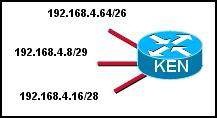
Refer to the exhibit. Which address is a broadcast address for one of the subnets that are shown in the exhibit?
192.168.4.3/29
192.168.4.15/29
192.168.4.65/26
192.168.4.255/24

>> Download PDF File

Note : Download Will Start in new tab.

>> Read More

gravatar

Dwonload Ajax ebook, download Creating Web Pages with Asynchronous JavaScript and XML ebook, ajax tutorial ebook with php

Download Ajax eBook Free


>> Download This Book (Direct Link)

Note Download will be Open in a new tab.

gravatar

Download HTTrack Offline Browser

Download HTTrack Offline Browser


HTTrack is a free (GPL, libre/free software) and easy-to-use offline browser utility.

>> Download This Software (Direct Link)

Note Download will be Open in a new tab.


It allows you to download a World Wide Web site from the Internet to a local directory, building recursively all directories, getting HTML, images, and other files from the server to your computer. HTTrack arranges the original site's relative link-structure. Simply open a page of the "mirrored" website in your browser, and you can browse the site from link to link, as if you were viewing it online. HTTrack can also update an existing mirrored site, and resume interrupted downloads. HTTrack is fully configurable, and has an integrated help system.

gravatar

Download Offline Explorer free

Download Offline Explorer


Offline Browser: Download Web sites to your hard disk for offline browsing.

>> Download This Software (Direct Link)


Note Download will be Open in a new tab.

gravatar

ccna 2 chapter 5 question and answer, cisco question and answer, cisco tutorial question ans answer,ccna 2 CCNA 2 routing protocols and concepts

CCNA 2 Chapter 5 Question and Answer


1.
Refer to the exhibit. The network that is shown is running RIPv1. The 192.168.10.0/24 network was recently added and will only contain end users. What command or set of commands should be entered on Router1 to prevent RIPv1 updates from being sent to the end user devices on the new network while still allowing this new network to be advertised to other routers?
Router1(config-router)# no router rip Router1(config-router)# network 192.168.10.0
Router1(config-router)# no network 192.168.10.0
Router1(config-router)# passive-interface fastethernet 0/0
Router1(config-router)# passive-interface serial 0/0/0
2.
Refer to the output from the show ip route command. What can be concluded from the output of this router command?
A preferred route to the destination has not been set.
There are two equal cost paths to network 1.0.0.0.
Both interfaces are being used equally to route traffic.
A variance must be set to load-balance across multiple paths.

>> Download PDF File

Note : Download Will Start in new tab.


3.
Refer to the exhibit. The Ethernet interface on Router2 goes down and the administrator notices that the route is still in the Router1 routing table. How much longer will Router1 keep the down network in its routing table before marking it as possibly down?
30 seconds
90 seconds
155 seconds
180 seconds
255 seconds
4What is the default update period in seconds for the RIP routing protocol?
10
12
15
20
30
60
5Which of the following is considered a limitation of RIP v1?
RIP v1 does not send subnet mask information in its updates.
RIP v1 is not widely supported by networking hardware vendors.
RIP v1 consumes excessive bandwidth by multicasting routing updates using a Class D address.
RIP v1 requires enhanced router processors and extra RAM to function effectively.
RIP v1 does not support load balancing across equal-cost paths.
RIP v1 authentication is complicated and time-consuming to configure.
6Which command will display RIP activity as it occurs on a router?
debug ip rip
show ip route
show ip interface
show ip protocols
debug ip rip config
show ip rip database
7What are three characteristics of the RIPv1 routing protocol? (Choose three.)
supports the use of VLSM
uses hop count as a metric
considers a metric of 16 as infinity
has an administrative distance of 110 by default
includes the destination IP address and subnet mask in routing updates
calculates metrics using the Bellman Ford algorithm
8.
Which of the following would be the correct command sequence to enable RIP on Router B for all connected networks?
RouterB# router rip
RouterB(router)# network 210.36.7.0 RouterB(router)# network 220.17.29.0RouterB(router)# network 211.168.74.0
RouterB(config)# router rip RouterB(config-router)# network 198.16.4.0RouterB(config-router)# network 211.168.74.0 RouterB(config-router)# network 199.84.32.0
RouterB(config)# configure router rip RouterB(config-router)# network 210.36.7.0RouterB(config-router)# network 199.84.32.0 RouterB(config-router)# network 211.168.74.0
RouterB(config)# router rip RouterB(config-router)# network 198.16.4.0RouterB(config-router)# network 210.36.7.0 RouterB(config-router)# network 211.168.74.0
RouterB(config)# router rip RouterB(config-router)# network 198.16.4.0RouterB(config-router)# network 210.36.7.0 RouterB(config-router)# network 220.17.29.0
9.
Refer to the exhibit. All routers are configured with valid interface addresses in the indicated networks and are running RIPv1. The network is converged. Which routes are present in the routing tables?
All routers have all routes in their routing table.
All routers have all /30 routes, but do not have /24 routes in their routing table.
All routers have all /30 routes. Routers A and E also have some of the /24 routes in their routing table.
All routers have all /30 routes. Routers B and D also have some of the /24 routes in their routing table.
Routers A and E have all routes. Routers B and D have only /30 routes in their routingtable.
Routers A and E have only /24 routes. Routers B and D have only /30 routes in their routing table.
10What will happen if an interface IP address is entered for the address portion of the network command in a RIPv1 configuration instead of a network address?
The router will reject the command.
A route to the host address will be added to outgoing RIP updates.
A route to the host address will be added to the routing table.
All interfaces in the same classful network as the configured address will be included in the RIPv1 routing process.
11.
Refer to the exhibit. Router1 and Router2 are running the RIPv1 protocol. The network administrator configures the command network 10.1.0.0 on Router1. What network will Router1 advertise to Router2?
10.1.0.0/16
10.1.0.0/8
10.0.0.0/16
10.0.0.0/8
12.
Refer to the exhibit. All routers in the exhibit are running RIP v1. The network administrator issues the show ip route command on router A. What routes would appear in the routing table output if the network is converged? (Choose two).
R 192.168.2.0/24 [120/1]
C 192.168.2.0/24 [120/1]
R 10.10.3.0/24 [120/0]
C 10.10.3.0/24 [120/1]
R 10.10.1.0/24 [120/2]
R 10.10.1.0/24 [120/3]
13.
Refer to the exhibit. A network consists of multiple routers. What can be verified when the show ip protocols command is issued on one of the routers in the network?
whether all routes in the network have been properly added to the routing table
routing protocol configuration in use for IP on this router
operational status of routing protocols in use on all routers in the network
routing metric of each network that is listed in the routing table
14.
Refer to the exhibit. What can be concluded from the routing table output of router B?
A static default route has been configured on B.
The default-information originate command has been entered on A.
All traffic that is destined for 192.168.1.1 will be sent to address 0.0.0.0.
Hosts on the 10.16.1.0/27 network have 192.168.1.1 configured as the default gateway address.
15The following line was displayed in the output of the show ip routecommand. R 192.168.3.0/24 [120/3] via 192.168.2.2, 00:00:30, Serial0/0 What is the value of the routing metric?
3
12
20
30
120
16.
Refer to the exhibit. All routers that are shown are running the RIP routing protocol. All unknown IP traffic must be forwarded to the ISP. What router or set of routers are recommended to have both a default route and the default-information originatecommand issued to implement this forwarding policy?
only Router1
only the gateway router
all routers in the network
only the routers with LANs needing Internet access
17.
Refer to the exhibit. Router1 is running RIPv1. What command was entered into Router1 to configure the gateway of last resort?
no auto-summary
ip default-network 0.0.0.0
ip default-gateway 10.0.0.0
ip route 0.0.0.0 0.0.0.0 S0/0/1
18Which command or set of commands will stop the RIP routing process?
RouterB(config)# router rip RouterB(config-router)# shutdown
RouterB(config)# router rip RouterB(config-router)# network no 192.168.2.0
RouterB(config)# no router rip
RouterB(config)# router no rip
19Which two statements are true regarding the characteristics of RIPv1? (Choose two).
It is a distance vector routing protocol.
It advertises the address and subnet mask for routes in routing updates.
The data portion of a RIP message is encapsulated into a TCP segment.
The data portion of a RIP message is encapsulated into a UDP segment.
It broadcasts updates every 15 seconds.
It allows a maximum of 15 routers in the routing domain.
20.
Refer to the exhibit. RIPv1 is running on all three routers. All interfaces have been correctly configured with addresses in the address ranges that are shown. Which route would you see in the routing table on router CHI if the routers are configured with the commands that are displayed in the exhibit?
192.168.0.4/30
192.168.0.0/24
192.168.0.0/16
192.168.0.32/27
21Refer to the exhibit. The Ethernet interface on Router2 goes down and the administrator notices that the route is still valid in the routing table of Router1. How much longer will it take for Router1 to mark the route invalid by setting the metric to 16?
30 seconds
90 seconds
155 seconds
180 seconds
255 seconds

>> Download PDF File

Note : Download Will Start in new tab.